Personal Skill Set

30th September 2024

The task for this lecture is to create a SWOT in term of my soft and hard skills as a creative and future business I wish to make for myself as an artist.

ANALYSIS OBJECTIVES

  • Review my arts practice
  • Develop a creative business plan

INTERNAL FACTORS

STRENGTHS +

Understand financial planning
Have reasonable techniques across different mediums
Have an unusual approach to how I use my different skills to create across mediums
Have an interest I’m really passionate about and are my main subject and inspiration for my work
Have a good understanding of the range
of work I want to produce

WEAKNESSES –

Poor at marketing myself
Not really mastering any particular skill because I create across a lot of mediums. Need to refine
what I use and how I use it.
Don’t create enough and experiment – lack the confidence
Don’t have the tools rely on access to
University facilities for some things
Haven’t built a relevant portfolio

EXTERNAL FACTORS

OPPORTUNITIES +

I already have access to a customer base I just need to promote myself because I am immersed in the
lifestyle
It’s a niche area and lots of opportunities
to get work out there

THREATS –

Feel the marketing is already saturated with artists
It’s a niche area

ANALYSIS SUMMARY

  • My lack of confidence in whether there is room for my style of work in a saturated market is
    holding me back
  • I need to be more confident at promoting myself and using social media effectively
  • I need to build more of a portfolio
  • The opportunities are there – I am holding myself back.

Business Model and Financial Planning

As a mixed media artist I have a varied range of work, using ceramic, paint and print. I have thought about my business model and how it can be unique to myself and stay true to my brand and how authentic I want it to be. Because I also love photography it is relevant that I incorporate my photographic skills in how I produce my artistic creations. It also takes away an issue of copyright as I am the photographer and own the reference image.


My business model is based from photograph to finished piece. The idea is that for my more basic pieces I use photographs from my own library of images. However, for my more bespoke commissioned pieces I will spend some time with the owner and their horse, taking photographs for reference and then using these to form my final piece. This way I get to understand the horse and its personality, how it interacts with it’s owner and hopefully capture some candid moments that can be incorporated into my final piece. it will help me with the emotions I like to convey in my work.

My initial idea on sales prices for my products are:

Lino Prints A4 £10 (unframed)
Lino Prints A4 £20 (Framed)

Ceramic Lino Relief Slabs A5 £35

Sculpture Horse Head 12cm £80

Paintings A4 £80
Paintings A3 £120
Paintings A2 £180

Bespoke Commissions Price on Application £75 deposit fee which covers the photoshoot for reference images.

As previously mentioned, I already have other part time income that covers my share of our household expenses per month. My income is already taxed and takes up my tax free allowance so any income from my art business will be taxed at 20%. NIC on profits less than £6,725 will be paid voluntary Class 2 @ £3.45 per week profits between £12,750 and £50,720 will pay Class 4 NIC at 6%. I also have a student loan to repay and this will be approximately £360 per year and this will also come out of my other income so isn’t factored into my Artist Income and Expenditure.

Year 1 Sales per month by product      

Horse Head Lino Relief Slab Lino Print Unframed Painting based on A3

1 x £80   1 x £35 2 x £10 = £20 1 x £120

Total Ceramic Sales  £115.00 Total Print and Painting Sales £140    

£255.00 Total projected Sales     per month in year 1

Direct Costs Ceramics Total £92.00

  • Expenses Clay  £38.00
  • Kiln Hires 2 per month  £24.00 based on price lists for hiring kiln space per https://www.kilnshare.com
  • Oxides, slips & Glazes  £30.00

Other Mediums Direct Costs £137.75

  • consumables = paints & inks  £42.75
  • Use of Printworks Facilities 2 x pm  £50.00
  • Papers  £45.00

I have not factored in my labour cost recovery, simply because I want my art to be affordable and to sell, and also because I have other income that covers my household bills. If I were to cover my labour costs it would make some of the smaller pieces a lot more expensive and harder to sell. It is a very difficult thing to balance when just starting an enterprise. In my experience it is about 18 months before you really start to break even.

With regards to capital expenditure I have gone for the option to hire facilities as with the time I have available to create artwork, initially I will not be producing enough to make the minimum number of sales to warrant investing in my own kiln or intaglio printbed.

  • Bath Potters Kiln Rhode Ecotop 60 kiln £3244.15 inc vat
  • Clay Slab Roller Gladstone 3ft Slab roller £1800 inc vat
  • Printing Press Handprinted.co.uk ABIG Printing Press with geared Plate 50×90 £2,700 inc vat

With my predicted sales, keeping level of productivity the same as year 1, it won’t be until year 4 that i could consider purchasing any capital equipment outright and if I’m able to hire kiln space and printing facilities it actually make more business sense to continue doing so.

These are very simple projections and costings of my cash flow, I have more detailed spreadsheets with it all worked out and a 5 year plan. I will review these budget predictions every year, it will be nice to see how far off the mark I am and what happens when I get my website and online shop up and running.
Studio Workspace

I’m really lucky in that I have a Summer House in my garden that is large enough to use as an art studio. It started out life as a home office whilst we had work done on our home, and I then took it over as an art studio in 2020 when I started on my student journey.

I could rent a studio space as there are a few places locally to me that offer studios to rent, The Cheddar Arts Quarte, Peoples Republic of Stokes Croft, The Old Quarry (when its been refurbished) and The Stables. The prices for the studio space depending on size and what you wish to work on range from £110-£300 pcm. That’s quite a lot of money for an emerging artist to commit to on a monthly basis. I have another income stream, but even I feel I would need to have a regular sales income from my art before I committed to it.

As a mixed media artist the hardest part has been to decide how I would like my studio to be set up, because working with clay and printing they both need different environments to work in. One is a clean environment but the other by it’s nature is quite dirty.

I am able to arrange it with an area to store papers flat and have a clean surface for preparing my lino prints and creating small print runs. I can arrange for a dirty area worktop in which I can model my clay and roll my slabs, ideally I don’t want to be doing both at the same time. I am able to hire the facilities at Print Works Weston for £25 a day, this means all my printing work can be done in a clean environment.
I also don’t have the room for too many large pieces of equipment and have found kiln hire locally that I can use for my ceramics at an average cost of £12 per firing. I also go to a ceramics group once a week and have the ability to create work there.

The main piece of equipment I will possibly consider purchasing is Clay Slab Roller at a cost of £1,800 including vat as it eases the process of ceramic relief tile portraits. Rolling the lino into the clay with the correct pressure to create a relief is quite taxing on the arms and shoulders, especially with the larger pieces.

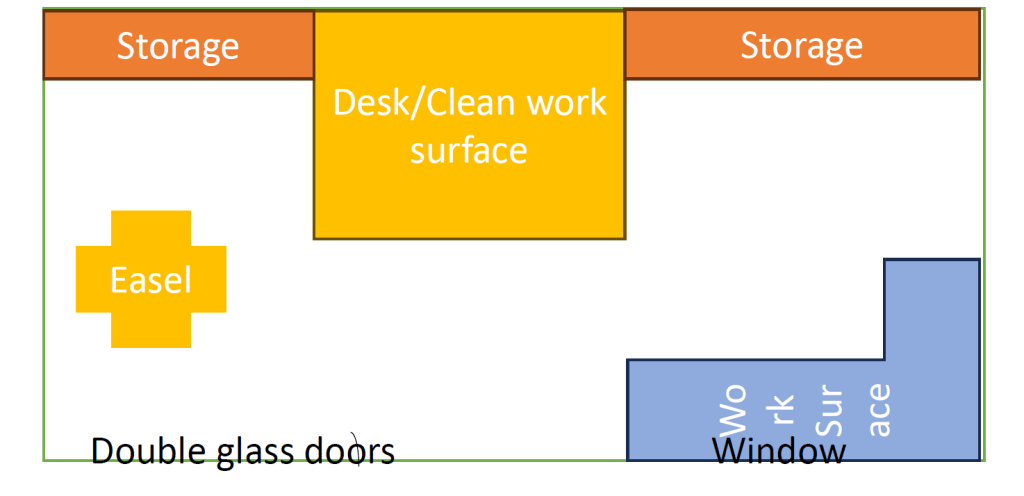
My studio space is very conveniently a nice rectangular shape with a window and french doors on the front side, which means I am able to have my paper storage and clean desk space on the back wall. Plenty of storage for paints, pigments and other bits and pieces on the short sides with room for another workspace and easle space.

Education, Employment and other opportunities

Once I’ve finished my degree I could follow any of the next steps:

  • Be an Artist
  • Continue with education and do a Masters
  • Go into Teaching, PGCE
  • Employment in a creative industry
  • Artist Residency

I have considered continuing my education and pursing a Masters, realistically I cannot continue straight on in education with this due to being a mature students and debts I need to try and clear. For me to do this, although funding is available through student finance, bursaries or grants etc, I do need to build up a bit of money in the pot to afford living expenses. I have looked at the following courses. The two in Bristol are full time and I definitely need to look at the funding I have available if I wish to pursue them in 2026.

Falmouth University has an online option which is a part time degree over two years and have three intake dates a year. This I am interested in purely becuase of the flexibility it offers me as a a mature student with family commitments. There are specific things that you need to attend Falmouth for as part of the course, however, as I have family in the area it would help reduce my living/hotel fees.

https://courses.uwe.ac.uk/E10D12/fine-art-printmaking

https://courses.uwe.ac.uk/E10112/fine-art

https://www.falmouth.ac.uk/study/online/postgraduate/fine-art

I would also need to check what bursaries or grants are available if I don’t qualify for student finance at the time. Grants and Bursaries change all the time and good places to keep abreast of what is available are:

In 2024 I could have applied for a grant from the Arts Council for funding to set up a studio and start up my business as a new and emerging artist. However, this year the funding is not available.

As well as the websites above to look for commissions and job opportunties, there is also the Artquest, Artnet and an – Artists Newsletter.

https://www.a-n.co.uk/

I actually think the Artists Newsletter is an invaluable resource in pulling everything together and keeping you up to date with news, views, and job opportunites. It also helps with a lot of small business advice tips like business admin, getting paid, insurance and contracts.

For me I am going to follow the set up my own arts practice route, and possibly do a Masters next year.

Exhibition Opportunities

There are a lot of exhibition opportunities, some are closed to just members of small collectives or associations. However there are a lot of Open Call opportunites to submit work for. I have signed up to the mailing lists for the following;

  • The Cheddar Arts Quarter
  • The Peoples Republic of Stokes Croft
  • Somerset Art Weeks
  • North Somerset Art Weeks
  • Bath Arts Fair
  • RWA Bristol

One of main websites I have subscribed to is the Olist https://theolist.oess1.uk/?status=openforentry

This is a brilliant website that lists UK open calls to artists and other opportunites. You get a regular email that updates you on new and currently being selected exhibitions. So far I haven’t managed to be selected for any, but I think it’s all a massive learning curve on how you present your work. Those decisions start with mounting and framing, then taking a photographs of your work that clearly depict the image or scultpure in it’s best light.

One thing I have learnt is that it is really hard to set up a good photograph, without reflections on any glass. Lighting is key, and once my studio space is set up I will be sorting out a soft box set up to take better images of my submissions.

A lot of open calls, especially those that are for an established society or association limit the number of submissions, so you need be clear that if a piece of work is a tryptic for example, that all three pieces are photographed how they would be displayed and that the description clearly mentions its a tryptic. The Society of Equestrian Artists have an annual exhibition for its members. As a Friend Member, I am able to submit one piece of work.

For my lino prints there is the Ironridge Printworks competition that I am interested in, I noticed this on the Olist Open Calls list.

Ironbridge Fine Arts

Printmaking Competition 2025

2025 Printmaking Competition showcasing the very best in printmaking – Enter by 4th August 2025 4pm

We’re delighted to announce that entries are now open for the Ironbridge Fine Arts Printmaking Open 2025 – a global celebration of printmaking excellence — championing the art, honouring the craft, and uniting a worldwide community of printmakers through innovation and tradition.

Open to both UK and International Printmakers, this year’s competition invites artists to submit up to 6 piece…

Full Details, Entry Terms & Conditions

Branding and Marketing

As an artist you are your own brand. Hard as it is, first impressions count, so you’re branding needs to reflect who you are. At least that is how I feel. It also needs to be consistent across websites, blogs and social media etc.

My biggest issue has been what name I use. Do I use my maiden name, my married name or just my forenames. I did research and there are already several artists called Helen White and even though my maiden name is Dougill, there is an artist called Helen Dougal and she comes up in website search engines as they automatically correct the spelling of my name to that with an ‘a’.

When I started my studies back on the foundation course I choose the name Helen Louise Art for my wordpress blog, as there weren’t any other pages on social media at the time and I have decided that this will be how I go forward with my brand. I am Helen Louise Art. I have purchased the domain name http://www.helenlouiseart.com and am yet to design and build my website.

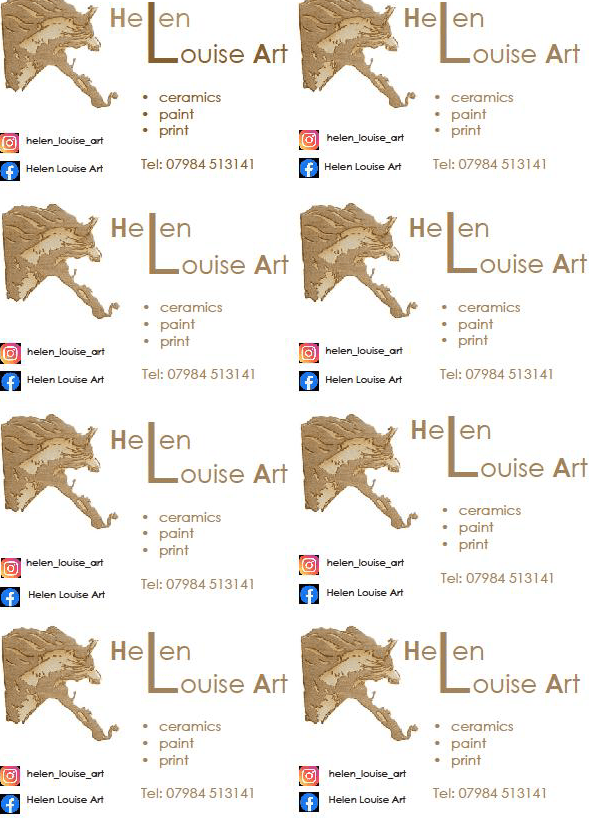
I toyed with a few ideas of fonts and how my name would look across one or two lines, and also chose a piece of my artwork as part of my logo. Because I try to use plant based or cotton rag handmade paper with my prints when I can, I want to use the same ethos in my business card and letterhead printing. I also wanted to use natural earthy colours, as it represents my link to nature and the tones and pigments I tend to use in my artwork.

on the back of my business cards I have small pictures of my current artwork, and these can be updated as I create more work. I have tried to include examples of my ceramic, painting and printing works.

How I show up and connect with other artists, galleries and organisations is important. Once my website is up and running I can at least hand my business card over when I visit galleries and art fairs as an introduction.

Contacts and Networking

It’s important to build up a good network of fellow artists and organisations that may have opportunities for you as a creative person. Stay up to date with what’s going on in your local area by signing up to email/newsletters and following artists on social media.

One of my fellow students is heavily involved in the Cheddar Arts Quarter and through her, we get news of exhibitions and workshops and other local opportunities to mix and share work locally. I am also involved with the People’s Rebulic of Stokes Croft in Bristol, in a financial administration capacity (my other career). Again they hold Art Fairs twice a year and an Art Exhibition once a year, this is also an opportunity to mix with other creatives and share my work locally. They also hold workshops as part of the Peoples Art Club. Local, but slightly further afield than where I live.

The beauty of these organisations is that you mix with creatives across different genres ie, street art, printing, ceramicists, jewellery makers, photographers etc. It a good way to share ideas and possibly hear of some collaboration opportunities.

In Weston-Super-Mare there is a small business called Print Works Weston and they hold a monthly print club and hire out their facilities and by getting involved in this way, I can meet up with fellow printers and be involved with any local exhibitions or print artist collaborations as they have contacts with the local Galleries and Somerset and North Somerset Art Weeks.

Attending workshops by other artists is also a good way of meeting people and finding out what is going on in the are. I attended a one day animal portrait workshop at The Sculpture School in Devon earlier this year.

I am also a friend member of the Society of Equestrian Artists, when the degree is finished I can look at joining their workshops and build up my skills as an equestrian artist. They also hold an annual exhibition which you can submit work to, a great way to be acknowledged in the field of equestrian art and build up contacts.

And then there is the social media following and building up your own audience by posting regularly and also by following artists and galleries online.

Instagram as @helen_louise_art

Facebook as Helen Louise Art

I follow a lot of artists and a few galleries, but I need to engage more with their content to start harbouring connections on social media and post more on my own accounts.

Galleries

As an emerging artist being aware of Galleries that would suit your work and developing a good relationship with one or two is a good way to boost your exposure to a wider audience for you work. Most galleries have an online shop as well in person sales in their physical gallery space.

For me, I would need to develop a connection with Galleries that are interested in animal, or more specifically equine art. I would also need Galleries that are interested in 3D work as well as 2D, and those that are interested in the quirky processes of creating art that combine one or two processes and different mediums.

Most galleries charge commissions on the work they sell which is usually around the 30%-50%. This is important to note when making your financial predictions because it is a cost of sale, and cost to your business. In once sense it reduces your taxable income, as in the UK we get charged on net profit. However, this means there is a possibility you are not covering your direct costs and overheads of your own art practice fully. Also, whatever price you sell at in a Gallery needs to be the same as your own website, espcially if you have a run of a limited edition print for example. It’s bad business practice to undercut a gallery, and not necessarily good business sense to over inflate your selling price because you need to cover the overheads and direct costs to ensure you’ve got enough money to live on.

Some Galleries run as collective like the Skylark Gallery in London. They are artist led and you pay a fee to join. They don’t charge commission but you sign up to do a day in the Gallery every 3 weeks. You fill out a form to apply to join. https://skylarkgalleries.com/pages/join-the-collective We have a smaller collective local to me in Cheddar, https://www.theartsquarter.com this is a smaller scale, but local artists can rent a shelf or wall space to sell their artwork. They occasionally have artist studios to hire and hold exhibitions and workshops. These type of galleries are a great way for solo practicitioners to develop a network and feel part of a wider community.

Having researched Galleries I would love to get my work in somewhere like the Rose Gallery in Northampton. They have a variety of artists in 3D and 2D work, but for me it’s their audience. They have a stand at some of the major equestrian events throughout the year. So for me it is a dream gallery for gaining exposure to my genre of work. https://www.therosegallery.co.uk/pages/gallery-event-calendar

More local, in Bristol is the Gala Fine Art Gallery. They support emerging artists and are interested in artists with distinct and expressive styles. Especially if they use painting with other creative processesses such as photograph transfer, screen printing and collage. Like most galleries across the country they have dedicated artist pages, arrange pop up exhibitions, and promote their artists at Art Fairs. https://www.galafineart.uk/

Being involved with a Gallery has a lot of positives if you find the right one for your work, you gain more exposure, you are part of a community, and can put on solo or joint exhibitions. Also, it can be expensive hiring space at Art Fairs etc and it is a way to help with the cost, especially if you do not have enough work to fill even the smallest space available.

I will be reaching out to the two Galleries above, hopefully manage to visit in person. To do that I need to get my branding organised and my website up and running, and a small portfolio of current works that I can share.

Developing A Range of Work

As an artist, one of the things that I need to consider when looking at my customer base and deciding who I wish to target is my range of work. Obviously I don’t want it to be too wide as that can get very confusing and difficult to market and easier to lose sight of your identity as an artist.

I already wish to specialise in equestrian art, this could already limit my audience. Although, being around horses and stable yards and embracing the whole lifestyle, there are other genres that can lead from this into pet and livestock images to boost the potential sales. Also, I am a mixed media artist and work with paints, ceramics and printing mediums and techniques. This makes it a bit easier to develop a range of works in the mediums that fit within a simple pricing strategy.

I decided I want my work to be affordable, even my higher priced products. I also want them to be good quality, which means I have to make a lot of pieces to perfect my techniques and have enough stock to either sell or have a portfolio to show customers what I can do as part of my portfolio. I need to be able to set a Low – Medium – High price range, so there needs to be a way of defining what would fall into those categories and what my typical market is that I’m aiming for.

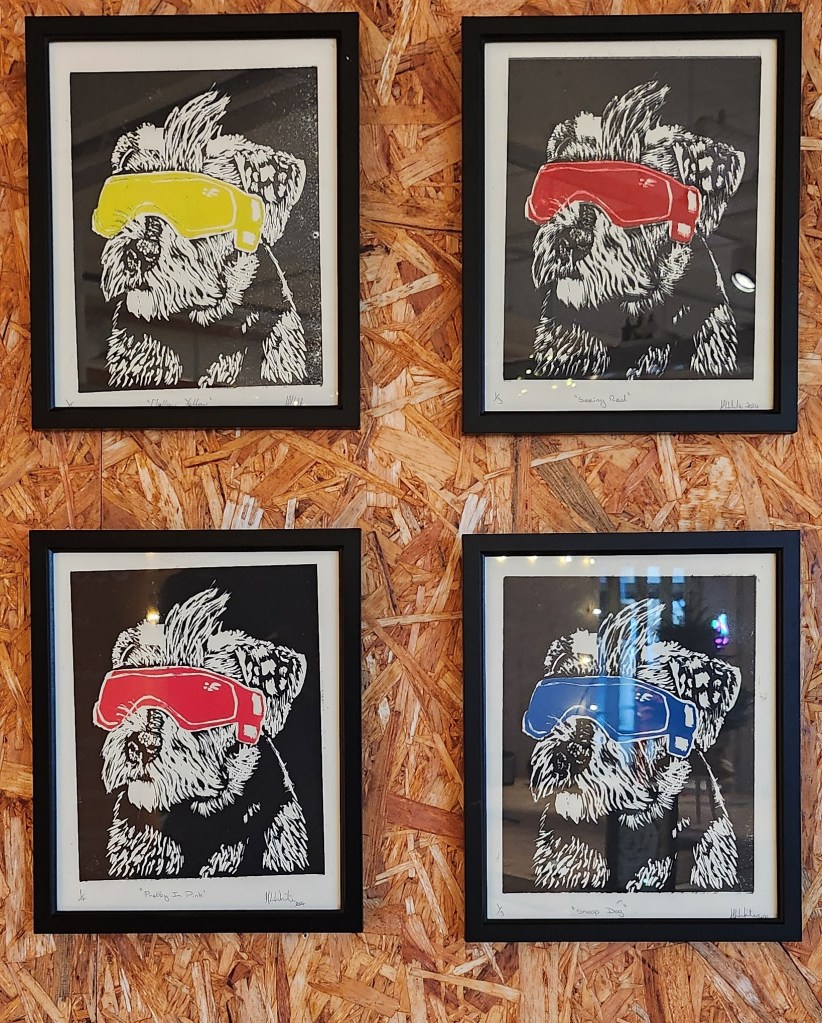
If I start with my linoprints. I use the lino’s for both printing and my ceramic relief work. If I follow through the methodical processes I go through, and from experience of selling the prints for £10 unframed and £15 framed at the UCW Pop Up Shops.

One A5 lino is used to create several pieces of work. The example shown for our Vision pop up shop, was a simple jigsaw lino, where you cut out the parts that are going to be printed in different colours and piece them back together. I would have a limited print, for this one each colour was a maximum of 10 so that is a maximum of 40 prints altogether. I then created three plaster reliefs of the image, that are able to be freestanding and then created some ceramic tile reliefs. My pricing for this would be:

  • Unframed print £10
  • Framed print £15
  • Plaster relief £30
  • Ceramic relief £45

These would be my lower range work and I’m hoping more popular due to the size they appeal to a wider range of customers than the larger sizes because they can either be free standing or hung in a small wall space.

My midrange work would be larger and/or more detailed to justify the increase in price. Again any lino prints would be a limited edition. And I would possibly only manage to do around 8 or 10 ceramic reliefs per image. My midrange work would be between £50-£95.

The higher range items would be more bespoke work, possibly one off pieces. Therefore I would price them around the £100-£185. I’m really conscious that these items wouldn’t sell as quickly or easily but the time taken create the detail in a lino cut A3 or over in size, would need to be recuperated somehow.

My paintings would probably be more on a commission basis, and these would be priced depending on the subject, the size and the medium used. I’m really conscious that I do not want to overprice myself out of the reach of everyday people, and have considered that in the current climate not everyone has a lot of disposable income these days.

I think the main market I am trying to attract are the normal equestrians like me that will splurge a bit on a bespoke commission but not into the £1,000’s as all our disposable money goes into the care and upkeep of our expensive hobby. I’m also as a booster to this income looking to attract the pet owner market and people who like wildlife and livestock. These more generic pieces also make a good stock to take to art fairs and sell in an online shop.

The reason I have decided to try and concentrate on the smaller prints and sculpture prints, is through discussions I’ve had with friends and fellow pony club mums about what they like and what they can afford. Also, whilst starting out I am limited on the time I have available as I need to keep my other paid income work going, so I am limited to what I can create with a dedicated 2 to 3 days in my week to building my art practice.

Market Research

30 September 2024

As a creative business I need to understand what the current trends are in my area of art. I follow a number of artists on social media and have a reasonable idea of how they market themselves and reach out to their potential clients.

One of the artists I follow on Instagram and Facebook is Tony O’Connor. He is known for being an equine artist and takes on a lot of commissions as well as some of his own portfolio pieces for sale. In his own words he does “other critters” too, such as pigs, donkeys, foxes and stags. I bought one of his limited edition calendars in 2024, it’s a good marketing tactic as I fulfilled my desire to have some of his artwork in an affordable way. For him as an artist it’s an avenue to get your work out there and another income stream. Tony has a shop on his website which concentrates on selling mainly fine art prints. He sells a few pieces via The Doorway Gallery in Dublin. His main outlet that he works towards every year to get new work on display is the annual Dublin Horse Show. I admire him because he is an accomplished sketch artist for his ideas and painter. He formulates his own artwork ideas and sketches them our before creating the larger pieces. He also works closely with an Equine Photographer and uses her images for some of his more classic style paintings. It seems to work really well for him, helped by the fact that he’s approachable and created a brand/business that really suits his personality and it comes through in all his social media posts and his own studio website. I think as an artist it’s really important to understand how much of you is your brand, something I already know I am going to find difficult. •https://whitetreestudio.ie

Christian Hook, https://www.christianhook.com , is another artist I follow and have enjoyed watching how his work has changed and developed over the years since I discovered his work. His work was really highlighted when he won the Sky Portrait Artist of the Year 2014. He has done portraits of several famous people including The Duke of Edinburgh and Dame Judi Dench. However, it’s his equestrian art that I started to follow him for. He has such a way of mixing realism with abstraction and you really get drawn into the world he creates. His work is displayed in higher end galleries and from the professional style to his website and videography of his work I feel he has a team of professional media and film creators supporting him. However, the style is still very much him and how his work is created. His portrait of Sue Thompson to commemorate the Hillsborough Families, was inspiring. The anthem of Liverpool FC is “You’ll Never Walk Alone” and I was inspired by how much time he spent with Sue, and that he use his barefeet to walk on the monochrome portrait. That element of being involved in the story and some how incorporating it in the image strikes a chord in how I wish to create my own art.https://www.youtube.com/watch?v=KjuOYClr3Qs

More recently I have started to follow Susan Benes. She is an equine artist who creates small scale sculptures, similar in price and size to the ones that I wish to create. She has written books and runs courses in how to create clay sculptures and supplemented her income in this way. •https://www.susiebenes.com

I follow a number of artists, ceramicists and printmakers on Instagram and Facebook. They represent a wide range of genre. The choose different ways of selling their work either from a shop on their own website, Etsy – which means sales fees, or via art fairs, shows and exhibitions, and galleries.

Regardless of how you wish to sell your work, there are costs to be covered in either exhibition space, art fair fees, gallery commission and bank fees ie, square, sumup etc.

I need to consider who is my market? Am I aiming for the lower range tourist passing trade, mid tier working professionals/ commissions, or higher range galleries that specialise in animal art. Who do I really want to attract and do I wish to limit the range/genre of works I create?